Week 1 · Module 1
College Expectations
The unwritten rules, syllabi, office hours, and how college really works: the things nobody tells you out loud.
By the End of This Module, You Will Be Able To:
- Identify at least three unwritten rules or norms of college that are rarely stated outright.
- Explain what office hours are and why showing up early in the semester matters.
- Describe what academic integrity covers, including violations students do not realize are violations.
- Choose one specific college expectation and make a concrete plan to act on it in your first three weeks.
Module 1 Lesson
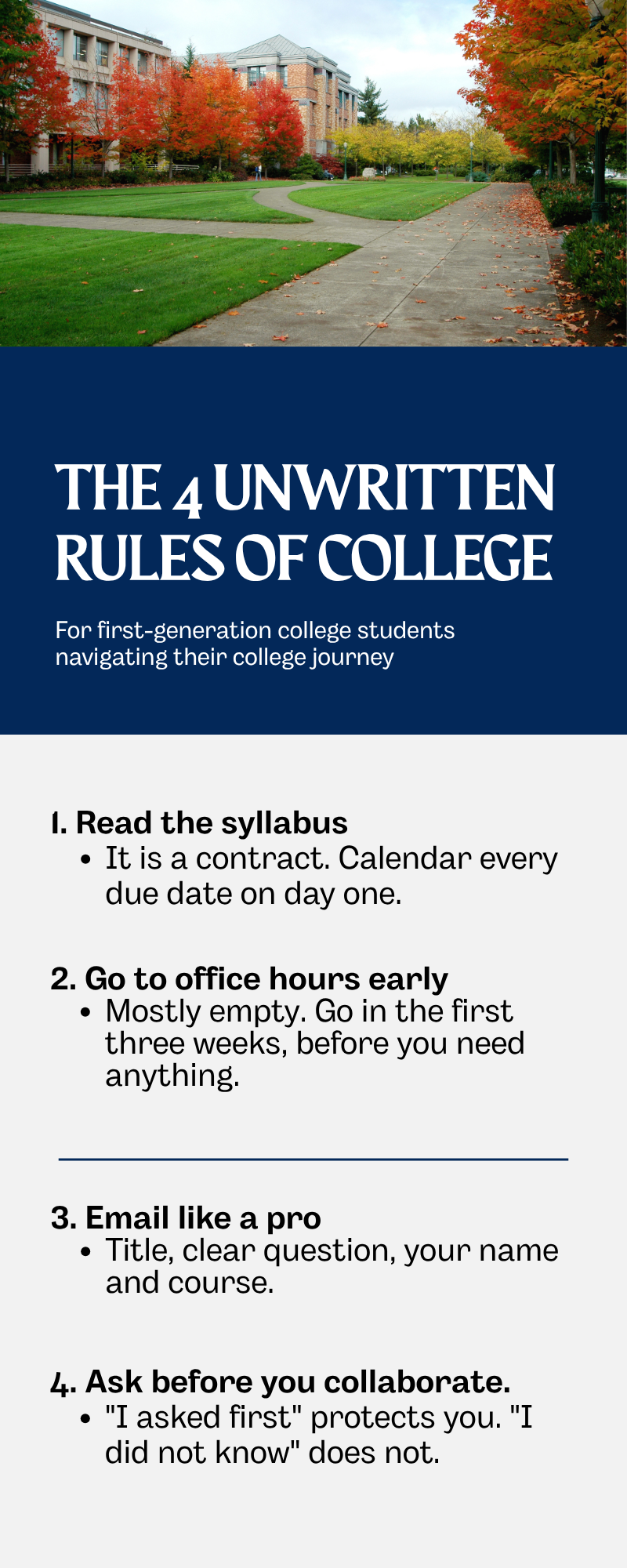
The Hidden Curriculum
College runs on a set of rules nobody writes down. There is the official version in the catalog, with credit hours and prerequisites and the academic calendar, and then there is the version that actually determines how your semester goes, which gets passed down at dinner tables in families where people have already been to college. Researchers call this the hidden curriculum: the unspoken rules that colleges assume you already know. Students whose families went to college pick this up without thinking about it, while first-gen students are expected to know it without ever being taught, and this is the part of the manual you were supposed to get and did not.
The Syllabus and Office Hours
Start with the syllabus, because it is the most underused document in college. Most students skim it once and never open it again, which turns out to be a mistake because the syllabus is a contract. It tells you exactly how your grade is calculated, when every assignment is due for the whole semester, what the late policy is, and how the professor wants to be contacted. When a student emails a professor about something already answered on the syllabus, the professor notices, and not in a good way. Read it on the first day, put every due date in your calendar that night, and check it before you email about anything.
Office hours are the single biggest gap between students who know the rules and those who do not. These are blocks of time, listed on the syllabus, when a professor sits in their office specifically to talk with students, and you do not need an appointment, a crisis, or a brilliant question to show up. Faculty consistently report that office hours go mostly empty, meaning the students who do show up get a relationship with that professor that others do not. Go in the first three weeks before you need anything, introduce yourself, and ask one real question about the material or the field. The professor who knows your name in September is also the one who might write your recommendation letter later, and the one more likely to help you out when something goes wrong in October.
How to Email a Professor
The way you contact a professor matters more than you think. An email that opens with “Hey” and no name reads differently than one that opens with “Hi Professor Lin.” Use their title, ask your question clearly, and sign your name and course. You are not being overly formal. It just shows you take their time seriously, and that matters.
Academic Integrity
Academic integrity is where good students get into trouble by accident. Everyone knows copying a test is cheating, but fewer students know that turning in the same paper for two different classes can be a violation, that working with a classmate on an assignment meant to be done alone is a violation, or that pasting a few sentences from a website without a citation is plagiarism even if you did not mean to steal anything. The rules vary by professor and school and are usually on the syllabus, so when you are not sure if something is allowed, ask first. “I did not know” does not protect you after the fact, but “I asked first” almost always does.
A Few More Things to Know
There are smaller unwritten rules too. Professors expect you to check your school email because that is where official information goes, not your personal account. Deadlines are usually firm, but many professors will work with you if you reach out before the deadline rather than after. Showing up matters even in classes that do not take attendance, because professors remember who was there, and none of this is difficult once someone tells you. The problem was never that first-gen students could not follow the rules but that nobody handed them the list.
None of this is meant to make college feel like a minefield. Once you can see these rules, most of them are pretty simple. Read the syllabus, go to office hours early, email professionally, and ask before you collaborate. That is really it.
Activity: Spot the Hidden Rule
Step 1. Find a real syllabus. Use one from a course you are registered for if you have it, or search your school's website for a sample syllabus in your intended major.
Step 2. Read it and pull out three pieces of information you would have missed if you only skimmed it: one about how your grade is calculated, one about a policy (late work, attendance, or how to contact the professor), and one specific due date.
Step 3. Write one sentence naming the unwritten rule from the lesson you are most likely to forget, and what you will do about it.
Instructor feedback. I respond within 48 hours and point out one thing on your syllabus that students most often miss but that affects their grade.
College Expectations Reflection (50 pts)
Download the assessment instructions and rubric.
What a Good Response Looks Like
Read through this before you write your own.
Technological Tools
What You'll Need
This module does not require any special software or accounts. As long as you have a working internet connection and a device, a laptop, desktop, or tablet works best, you can access everything you need.
← Previous
Assignment Due
Reflection Prompt
50 pts
Complete the assessment section above, then submit via the embedded form.
View full rubric →