Week 6 · Module 6
Career Preparation
You already have more to put on a resume than you think. The goal is not to look like you have ten years of experience. It is to show you show up and can communicate that in writing.
By the End of This Module, You Will Be Able To:
- Identify the core components of a resume appropriate for a first-year student with limited work experience, and write experience bullets using action verbs.
- Build a LinkedIn profile with at least four complete sections and a photo, using language that accurately represents your background.
- Describe at least two concrete networking strategies for a first-gen student who does not have prior professional connections.
- Locate your institution's career center and explain how to schedule an appointment.
Module 6 Lesson
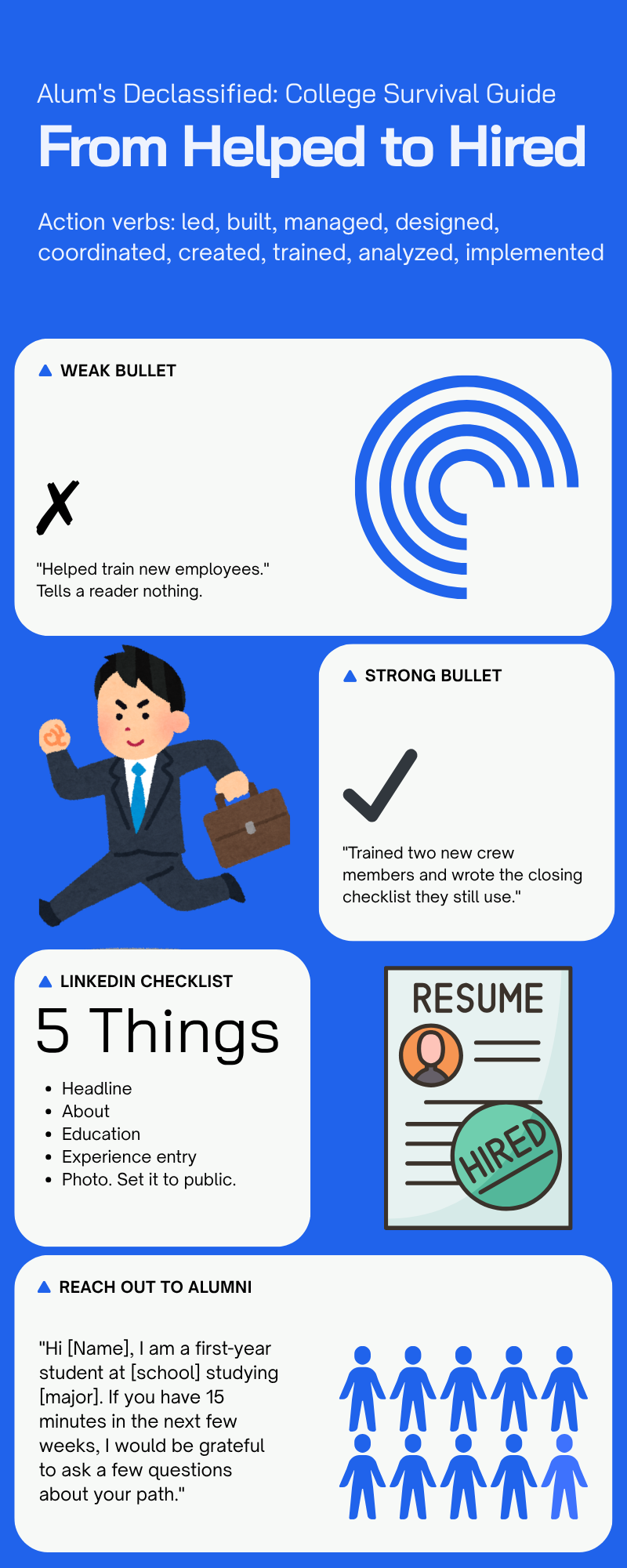
Most first-gen students walk into career preparation convinced they have nothing to put on a resume because there are no internships, no impressive titles, maybe one part-time job that does not feel like it counts, but that worry, while understandable, is wrong. A resume does not document your job titles; it documents what you are capable of, and a job where you trained two new hires and ran the register alone during a Friday rush is evidence of real capability. The job is to stop hiding that evidence.
Building Your Resume
Start with the resume even if you plan to focus mostly on LinkedIn, because the resume forces you to name your experience in plain language first. A first-year resume has five parts, and you already have material for most of them. The header is your name, a professional email (not the one you made in middle school), your city and state, your phone number, and your LinkedIn URL once you have one. Education comes next: your school, expected degree, graduation year, and GPA only if it is above 3.0. Experience is any job, volunteer role, or responsibility you held whether or not someone paid you, because babysitting counts, running concessions for your church counts, and being the household tech support counts. The skills section covers software, languages, tools, and certifications, and the optional last section holds awards, relevant coursework, or activities.
The part that trips people up most is the bullet points under each experience. The rule is to start every bullet with an action verb and never with “helped,” “assisted,” or “responsible for.” Use words like led, built, managed, designed, coordinated, created, trained, analyzed, or implemented. “Helped train new employees” tells a reader nothing, while “Trained two new employees during summer hiring and wrote the closing checklist they still use” tells a reader you can teach, document, and take ownership. Same job, completely different impression.
Setting Up LinkedIn
LinkedIn is not a place to show what you have already done. It is a place to be findable while you build what you are going to do, and that matters for first-gen students especially. Research by Granovetter (1973) showed that most job leads come not from close friends but from weak ties, meaning acquaintances and second-degree connections who happen to know about an opening you would never have heard about otherwise. You cannot benefit from a weak tie who cannot find you, and a complete profile is how you become findable before you have anything impressive to show.
Four sections do most of the work on LinkedIn. Your headline is not just your major: “First-year business student at UNC Chapel Hill interested in finance and nonprofit development” tells a reader where you are headed, while “Student at UNC Chapel Hill” tells them nothing. Your About section is three to five sentences in first person about who you are and what you are looking for. Your Education and at least one Experience entry carry the same content as your resume. Add a photo, because any clear, well-lit photo of your face is better than the gray default silhouette, and profiles with photos get looked at while profiles without them get skipped.
Networking
Networking sounds like something that requires already knowing important people, but for a first-year student it comes down to three habits. First, go to office hours because every professor is a professional in your field and a possible reference later. Second, schedule a career center appointment before applications open, not during, when everyone else floods in. Third, connect with two or three alumni from your school on LinkedIn using a short, specific message; here is one you can use almost word for word: “Hi [Name], I am a first-year student at [school] studying [major]. I saw that you studied [major] and now work in [field]. If you have 15 minutes in the next few weeks, I would be grateful to ask a few questions about your path. Thank you.” Most people ignore a vague request, but most people answer a specific, polite, time-limited ask from a student at their own school.
The Career Center
A career center appointment is not an interview. You do not need to dress up or have everything figured out. Just bring whatever you have, even if it is just your confusion, and someone will work through it with you. Find your career center this week, write down the building and the hours, and go early before the semester gets busy.
References
Granovetter, M. S. (1973). The strength of weak ties. American Journal of Sociology, 78(6), 1360–1380.
Activity: Experience Inventory
Do this before you build anything. You need raw material first.
Step 1. Brainstorm every job, volunteer role, responsibility, club, and skill you have had in the last four years. Do not filter. A two-week summer job counts. Watching your siblings counts. Being the person your family asks for tech help counts. List everything.
Step 2. Choose three items from your list and write each as one resume-style bullet point. Start each bullet with an action verb from the lesson, and include a specific detail or number wherever you can.
Step 3. Submit your full raw list plus your three bullet points.
Instructor feedback. I respond within 48 hours with a stronger version of whichever of your three bullets is the weakest, so you can see the technique applied to your own material before the graded assignment.
LinkedIn Profile and Career Self-Assessment (100 pts)
Download the assignment instructions and rubric.
What a Good Response Looks Like
Read through this before you write your own.
Technological Tools
What You'll Need
This module does not require any special software or accounts. As long as you have a working internet connection and a device, a laptop, desktop, or tablet works best, you can access everything you need.
← Previous
Module 5: Academic SuccessAssignment Due
LinkedIn Profile and Career Self-Assessment
100 pts
LinkedIn profile (public URL) + encouraged resume + 100–150 word self-assessment.
View full rubric →