Week 7 · Module 7
Emotional Resilience
This one is different. Every other module gave you information you could look up. This one is about something that does not have a Wikipedia page: what it actually feels like to be first.
If you are in crisis right now: Call or text 988 (Suicide & Crisis Lifeline). Text HOME to 741741 (Crisis Text Line). Your campus counseling center also offers crisis walk-in hours. Check their website.
By the End of This Module, You Will Be Able To:
- Define imposter syndrome and code-switching in the context of first-gen college students, and identify at least one personal example of each.
- Identify at least two campus mental health resources and describe how to access them at your institution.
- Apply at least one concrete coping strategy from the module to a specific emotional challenge you anticipate in your first semester.
- Write honestly about both a fear and a strength you are bringing into your first college semester.
Module 7 Lesson
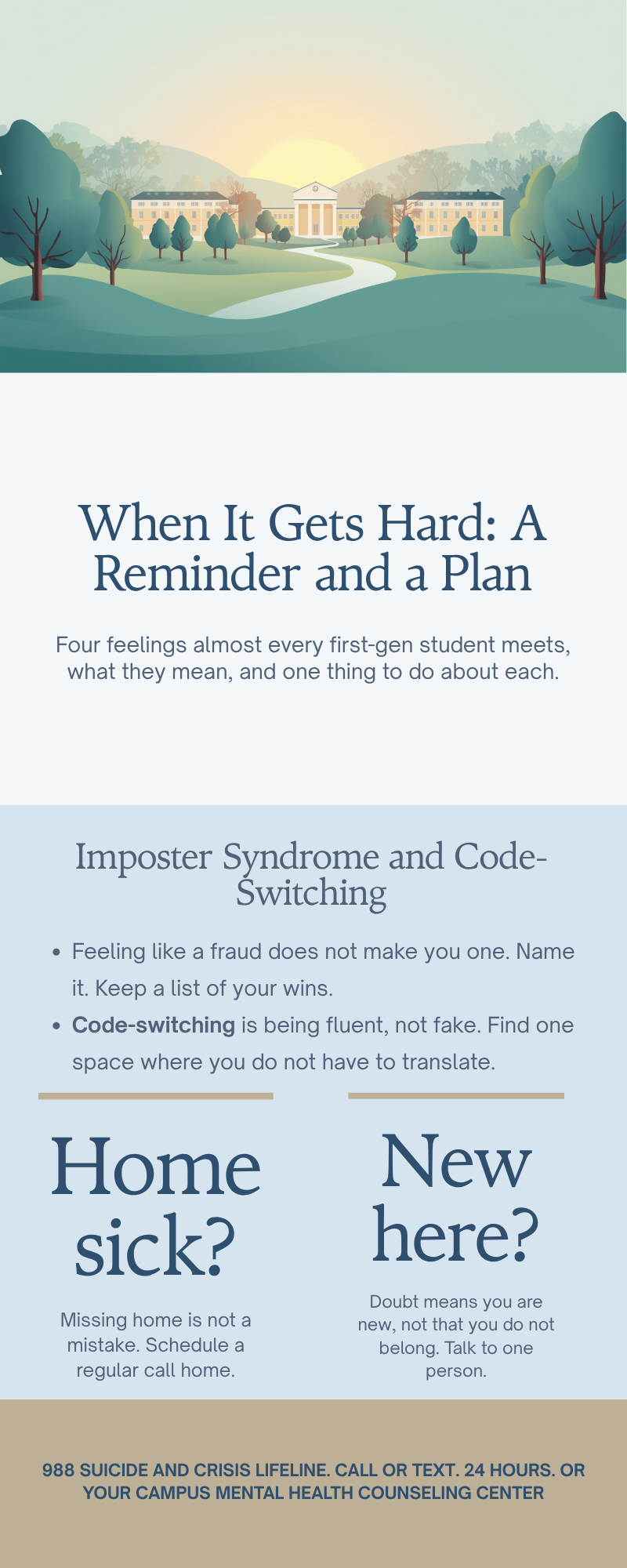
There is a version of college orientation that makes the whole thing sound exciting and manageable, and while that version is not entirely wrong, it leaves out the part where you sit in a 300-person lecture hall in your second week feeling certain that everyone around you got a manual you never received. This is about that feeling and the others like it, because they are the part nobody puts in the brochure and the part most likely to make a first-gen student quietly decide they do not belong.
Imposter Syndrome
Start with the one almost everyone gets. You earn an 87 on your first exam, and instead of thinking “I studied and I understood the material,” your first thought is “the test must have been easy.” That reflex has a name: Clance and Imes (1978) named it the impostor phenomenon, the experience of capable people who cannot accept their own success and always feel like they are about to be found out as a fraud. It hits hardest when you are the first person to enter a space, which is exactly the position of a first-gen student, and three things help: name it out loud when it happens because naming it interrupts the spiral, find one other person who feels it too because these feelings shrink in company, and keep a written list of what you have accomplished because the feeling lies and a list does not.
Code-Switching
You probably already switch how you talk depending on who you are with, because the way you text your cousins is not the way you will email a professor, and when that switch happens between home and campus, it can start to feel like you are being fake, like you left the real version of yourself behind. You are not being fake; you are being fluent. Code-switching is a skill, not a betrayal, and while it is tiring and the goal is not to perform it everywhere all the time, the practical goal is to find a few spaces on campus where you do not have to: a cultural organization, a first-gen student group, an affinity space, those rooms where you get to stop translating.
Homesickness
Homesickness does not mean you made a mistake. Say that again on a hard night. Missing your neighborhood, your food, your language, the sound of your house is not weakness and not a sign you should not have left. Many first-gen students carry an extra layer of this, a guilt about leaving people behind, a feeling that going to college is somehow a betrayal of where you came from, but it is not, and going does not mean leaving them. Most students who make it through learn to call home on a schedule so that missing home becomes a rhythm instead of a flood.
Feeling Out of Place
The most important research finding in this module is called belonging uncertainty. Walton and Cohen (2007) describe it as the experience of doubting whether you fit in somewhere new, especially for students from groups that have not always been well represented in that space. Doubting whether you belong is not evidence that you do not belong; it is evidence that you are new to this place. Walton and Cohen (2011) found that students who saw their early struggles as normal and temporary, instead of proof they did not fit, did measurably better over the years that followed, and the students who get through it are not the ones who never feel the doubt but the ones who know what to do when it shows up.
Getting Support
It helps a lot to know where to go before you actually need it. Find your campus counseling center this week, write down the building, the phone number, and how to book an intake appointment, and save it in your phone now. An intake appointment is not therapy and you do not have to be in crisis to make one, and waitlists get long around midterms so doing this early is smart. For anything urgent, the 988 Suicide and Crisis Lifeline is available 24 hours a day by call or text, so put 988 in your contacts today the same way you would save any number you hope never to need.
None of this is meant to scare you. The fact that you are doing this before your first semester even starts says a lot. The students who take this seriously are the ones who are still here in the spring.
References
Clance, P. R., & Imes, S. A. (1978). The imposter phenomenon in high achieving women: Dynamics and therapeutic intervention. Psychotherapy: Theory, Research and Practice, 15(3), 241–247.
Walton, G. M., & Cohen, G. L. (2007). A question of belonging: Race, social fit, and achievement. Journal of Personality and Social Psychology, 92(1), 82–96.
Walton, G. M., & Cohen, G. L. (2011). A brief social-belonging intervention improves academic and health outcomes of minority students. Science, 331(6023), 1447–1451.
Activity: Emotional Landscape Mapping
Complete this before you write the reflection essay. It gives you the raw material for it.
Step 1. Name three specific emotional challenges you expect in your first semester. For each one, write the emotion, the situation that might trigger it, and one thing you would do about it based on what this module covered.
Step 2. Identify two mental health or support resources at your school that you did not know about before this module. Write what each one offers and how to access it.
Step 3. Identify one person in your life you can reach out to when things feel hard. Write their name and how you will contact them. This does not have to be a professional. A friend, parent, sibling, or cousin is fine.
Instructor feedback. I respond within 48 hours. If you name a campus resource, I confirm the access details are current. If your plan for handling a challenge is vague, I suggest one concrete way to make it more specific.
Self-Care Plan + Reflection Essay: Assignment 7 (75 pts)
Download the assignment instructions and rubric.
FINAL ASSIGNMENT
Assignment 9: College Readiness Portfolio
Compile your best work from all seven modules into a cohesive portfolio that demonstrates your growth and readiness for college. Include a short recorded introduction. 150 pts
View assignment detailsWhat a Good Response Looks Like
Read through this before you write your own.
Technological Tools
What You'll Need
This module does not require any special software or accounts. As long as you have a working internet connection and a device, a laptop, desktop, or tablet works best, you can access everything you need.
You made it through all 7 modules.
Complete the final portfolio (Assignment 9) to receive your certificate of completion.
View Final Portfolio Assignment →← Previous
Module 6: Career PreparationFinal Step
College Readiness PortfolioAssignment Due
Self-Care Plan + Reflection Essay
75 pts
Three coping strategies, one resource, and a 400–600 word essay.
View full rubric →Crisis Resources